Metrics
Claude Code, Cursor and Copilot analytics compared
What the built-in analytics of Claude Code, Cursor and GitHub Copilot each report, per their docs, and what only a cross-tool view can show a team.

By Angel Lindarte
6 min read
We measured a Release Before Ready AI hackathon in Bogotá: 9 builders, 91,129 lines written with AI agents, 289 commits and up to 19 agents running at once.
By Angel Lindarte (opens in a new tab)
Cofounder & CTO
Published 7 min read

Ask how much of a team’s code is written by AI and the answers you find are company claims and survey replies: someone says a share of their code, nobody shows the counting. We wanted one number we could stand behind, so on 7 November we measured a whole day of people building with coding agents, from the first coffee to the last demo.
Release Before Ready (RBR) is a monthly build day and AI hackathon across Latin America where people meet to create for the joy of creating. The format is simple: coffee and introductions, a long block of building, lunch, more building, then demos and networking. 500 Global, Descubre.vc and Nexcar organize it, and HubBound provided the data and AI measurement in collaboration with the RBR team.
The Bogotá edition ran on 7 November 2026 from 09:30 to 22:00, with a lot of energy in the room and, as you would expect, a lot of AI. The next stops are Santiago on 14 November (Startup Chile Co-Work Latam), Mexico City on 21 November (Flexoffices Juárez, edition #10) and San Luis Potosí on 28 November (Parque de Emprendimiento e Innovación, ITESM).
Nine builders wrote about 91,000 lines of code with AI agents in the Bogotá build day: 91,129 lines across 289 commits, with 122,337 lines added in total across those commits. That is about 10,000 AI-written lines per builder.
| What we measured | Result |
|---|---|
| Builders | 9 |
| Lines written with AI | 91,129 |
| Lines added in total | 122,337 |
| Commits | 289 |
| Agent hours (active time) | 33.2, or 3.7 per builder |
| Agent actions (edits, commands, searches) | about 10,000 |
| Tokens (input and output, all models) | 2.48 billion |
| AI spend at list price | US$710, about US$79 per builder |
| Saved by prompt caching | US$9,998, 93% less than it would have cost |
The agents succeeded on the first try in 99% of their actions, and an average prompt kept an agent busy for 26.2 minutes. The average agent session lasted 1 hour 43 minutes, and the longest ran 8 hours 8 minutes.
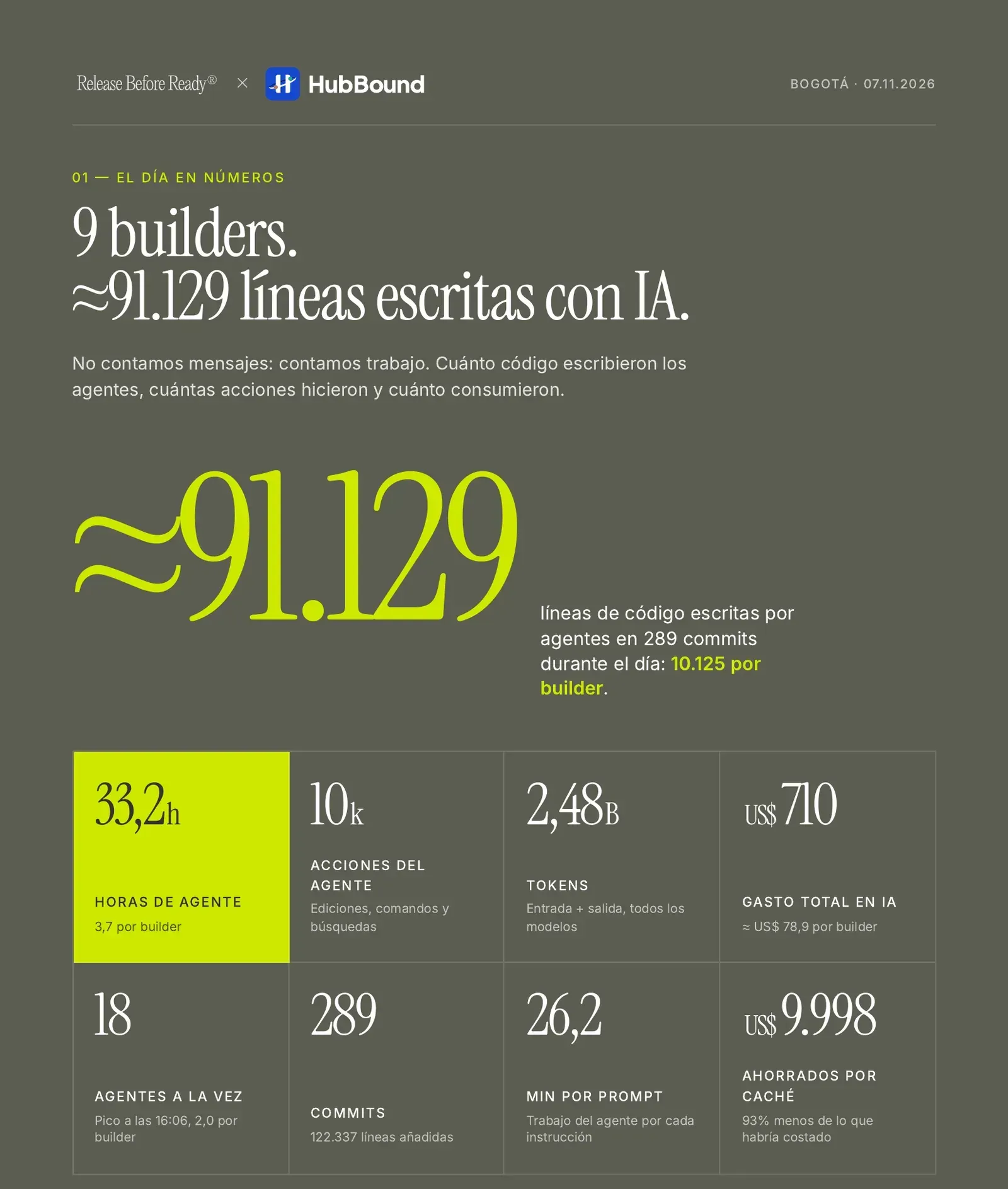
The day in numbers, from the report (in Spanish).
We connected every coding agent in the room to HubBound and counted work, not messages. Participants joined voluntarily and installed the HubBound CLI when they arrived, so the sessions of their coding agents were reported while they built.
For each agent session we recorded the active time (the minutes the agent was executing, not the minutes it waited for a person), the agent actions, the tokens, the cost at list price and the model. From each local commit, only the count of lines the AI wrote and the lines the person wrote arrived. The code never left the computer, and every figure in this article is an aggregate. HubBound Analytics works on the same signals for a team: sessions, tokens, cost, cache savings, commits and code lines.
We chose lines and agent actions over chat counts or hours at a desk because they describe what happened to the codebase. A long conversation can produce nothing, and a short one can produce a feature.
Up to 19 coding agents ran within the same 15-minute window, at 16:15 (the report’s live counter peaked at 18 at 16:06), and 10 of them kept working on their own through lunch. One builder ran 6 agents in parallel. Nine people, then, behaved less like nine typists and more like a small group of people coordinating a larger group of agents.
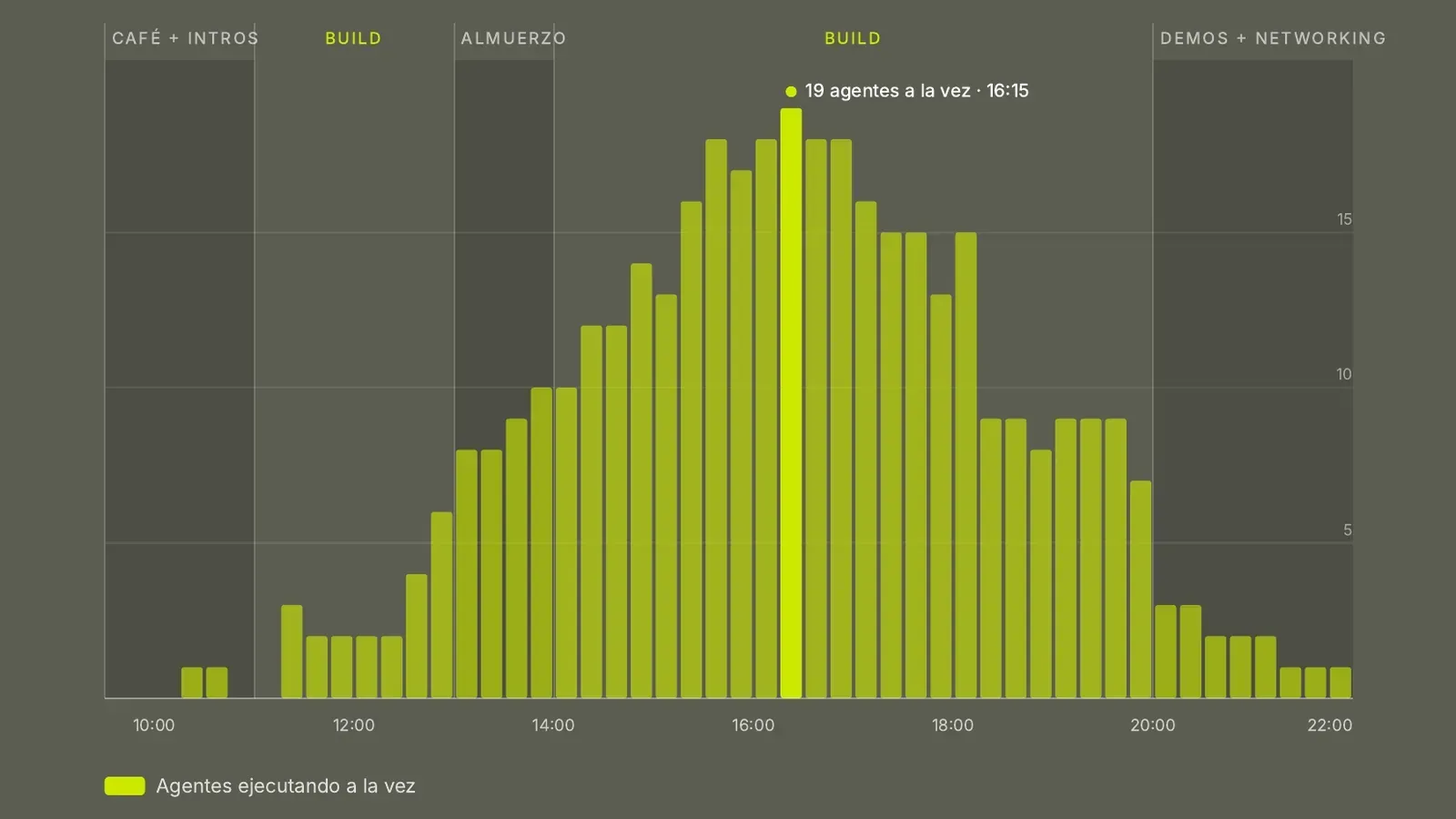
Agents running at the same time, every 15 minutes, across the agenda (from the report, in Spanish).
By active time, Claude Code did 92% of the work and GitHub Copilot 8%. By tokens, the split across models was Claude Opus 48%, Claude Sonnet 26% (25% and 1% across two versions), Claude Fable 18%, GPT-6 Luna 7% and Claude Haiku 1%, with 222,000 reasoning tokens along the way. The skills used most included brainstorming, writing-plans, subagent-driven-development, using-git-worktrees, claude-api and frontend-design. Several of those are about planning and splitting work before writing it, which fits a day where the interesting number was how many agents ran together.
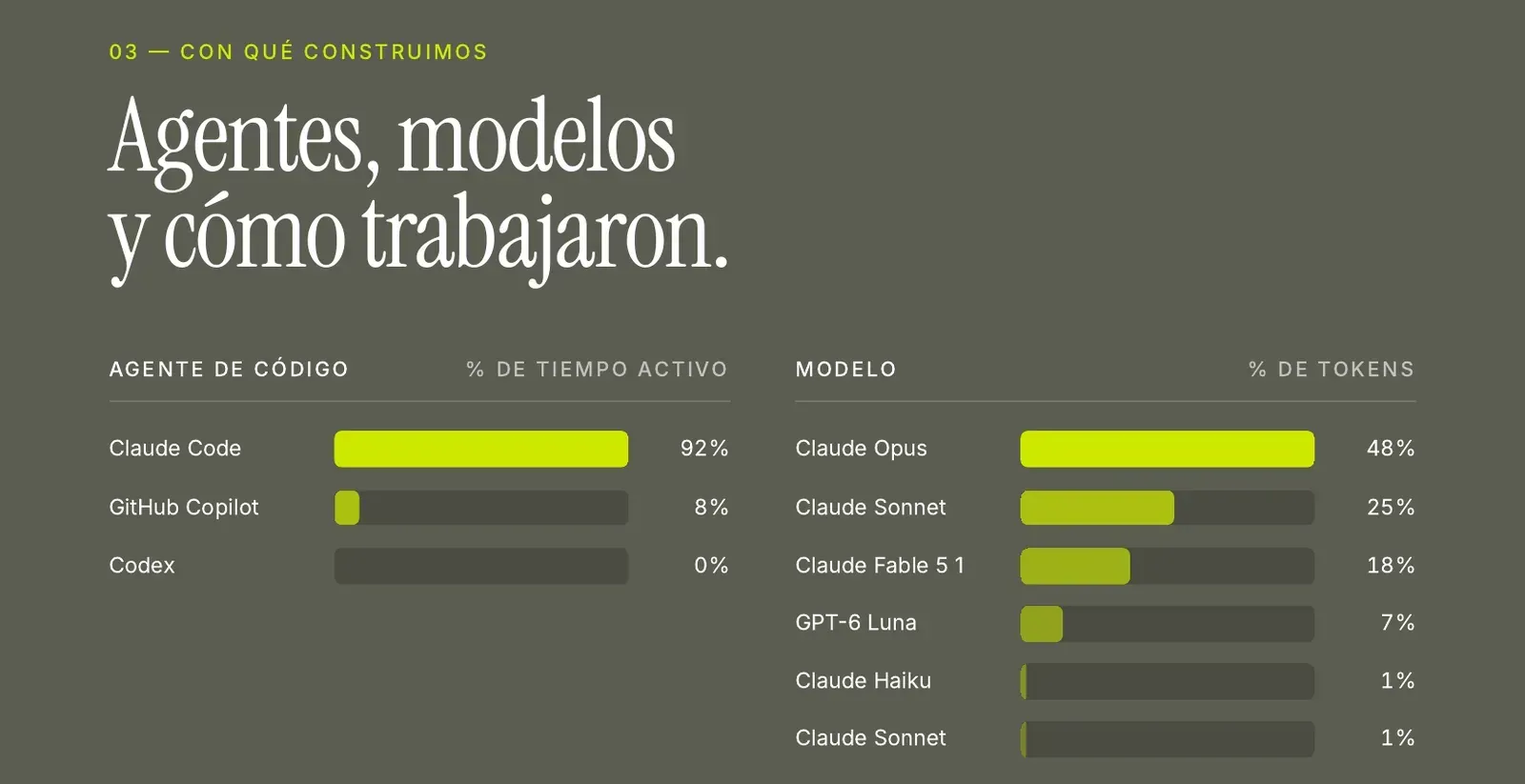
Coding agents by active time and models by tokens (from the report, in Spanish).
Agents saved 76 memories in HubBound Memories during the build day, and they looked memories up 1,083 times. Eight of the nine builders saved at least one, which comes to about 9.5 per builder, and 17 memories were shared with the whole team.
Decisions were 41% of what got saved, gotchas 17%, bugfixes 16%, preferences 14% and procedures 4%, with 8% in other types. The lookups are the part we like most: agents searched memories before deciding something or repeating a mistake someone had already made that day. Memories are part of the Context Bundle, and agents save and search them through the hubbound-memories MCP server.
Each builder received a personal credential with their own numbers, and the event closed with a seven-page co-branded report, “Release Before Ready × HubBound”, titled “Lo que construimos antes de estar listos”. HubBound built both for the event from the data it measured. They are not a feature you switch on in the product.

The cover of the report every builder and the organizers received (in Spanish).
The report goes through the day in numbers, the pulse of the day (how many agents ran at once every 15 minutes across the agenda), agents and models, what the agents learned, the standouts and the next stops. The standouts were awards for the most productive builder, the most tokens, the most savings, the most agents in parallel (the “orchestra conductor”), the most delegating and the most memories. This article keeps to aggregates.
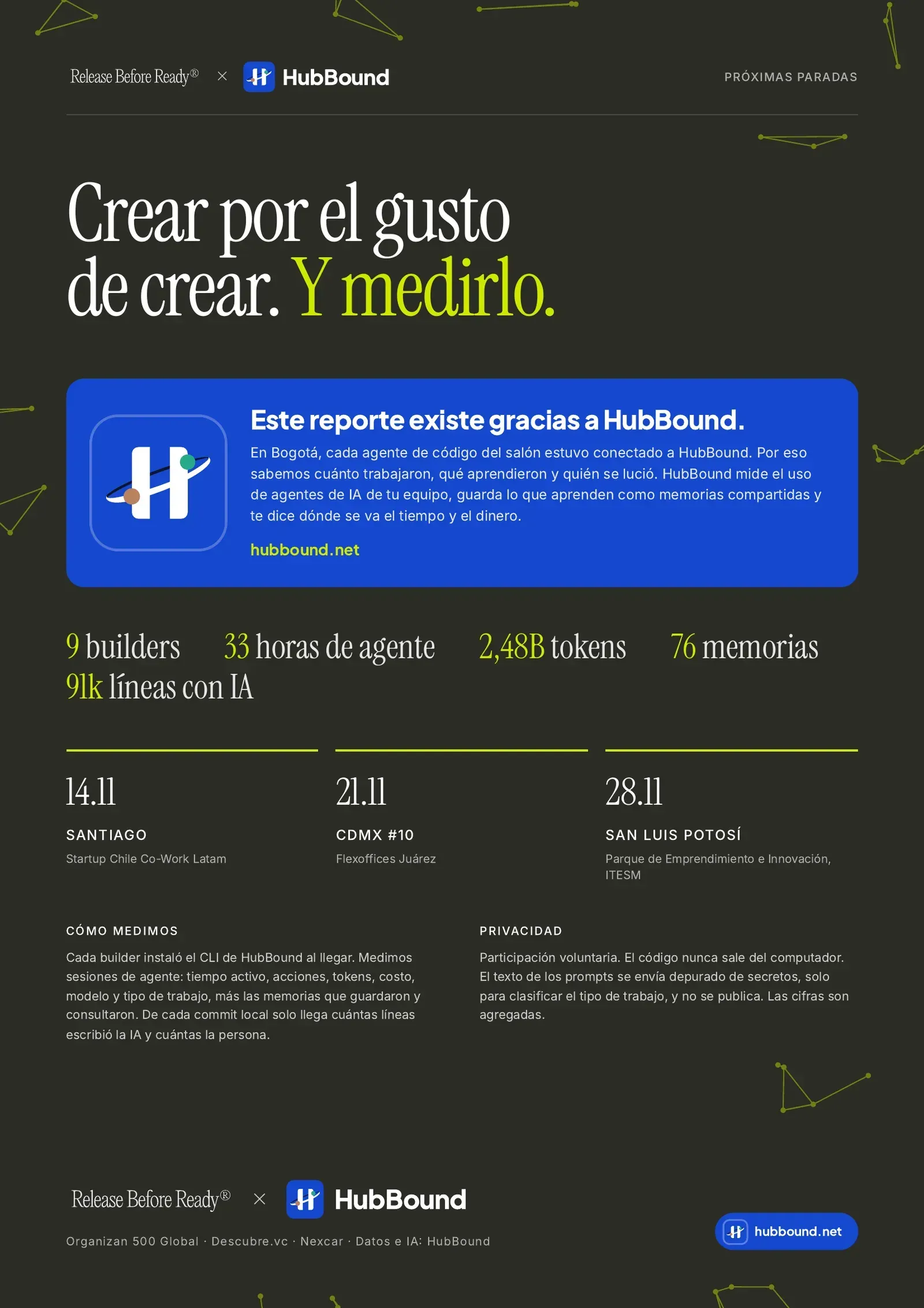
The closing page: headline figures, the next stops and how the day was measured (in Spanish).
They describe one day, nine volunteers and a build day where people start fresh projects, so they do not predict what a team maintaining an old codebase will see. Lines of code are also a blunt unit: a share of lines written with AI says how the code got typed, not whether it was good, reviewed or needed. Cost is the list price of the tokens consumed, not an invoice. And lines added say nothing about deleted code.
We would not read it as productivity either. It is an adoption and activity measurement, the same distinction that separates adoption from productivity in any engineering team.
Count work, not messages. Lines written with AI, agent actions and active agent time told us more about the day than prompt counts or hours in a chair, and they are the signals a team can keep collecting after the event ends. If you want to start, connect your coding agents to a measurement you control, keep the unit as simple as lines per commit, and share only aggregates.
What stood out was the shape of the work: 19 agents running at once for nine people, and agents that kept going while everyone ate lunch. Counting that is a different job than counting seats, and HubBound Analytics is where a team keeps doing it after the event. For the terms used here, the glossary has the definitions.
More articles from the HubBound blog, starting with the ones on the same topic as this one.
Metrics
What the built-in analytics of Claude Code, Cursor and GitHub Copilot each report, per their docs, and what only a cross-tool view can show a team.
By Angel Lindarte
6 min read
Metrics
How to calculate the return on AI coding tools: every cost line, a value model with an explicit capture rate, a worked example and the numbers to measure.

By Omar Contreras
6 min read

Metrics
Teams can reach near-universal AI use and still ship at the same pace. What the METR, Faros and DORA research shows, and how to measure both without mixing them up.
By Omar Contreras
7 min read
Book a demo and we'll walk through Artifacts, Kits, distribution and metrics with the tools your developers already use.